
Meta Description: Prime Minister Shehbaz Sharif highlights Pakistan’s economic recovery, IMF support, regulatory reforms, and opportunities for youth and foreign investment, signaling a path toward growth and stability.
Focus Keywords: PM Shehbaz Sharif economy, Pakistan economic growth 2025, IMF Pakistan support, Pakistan regulatory reforms, foreign investment Pakistan, youth employment Pakistan, national tariff policy Pakistan
Introduction: Pakistan’s Economic Recovery Under PM Shehbaz
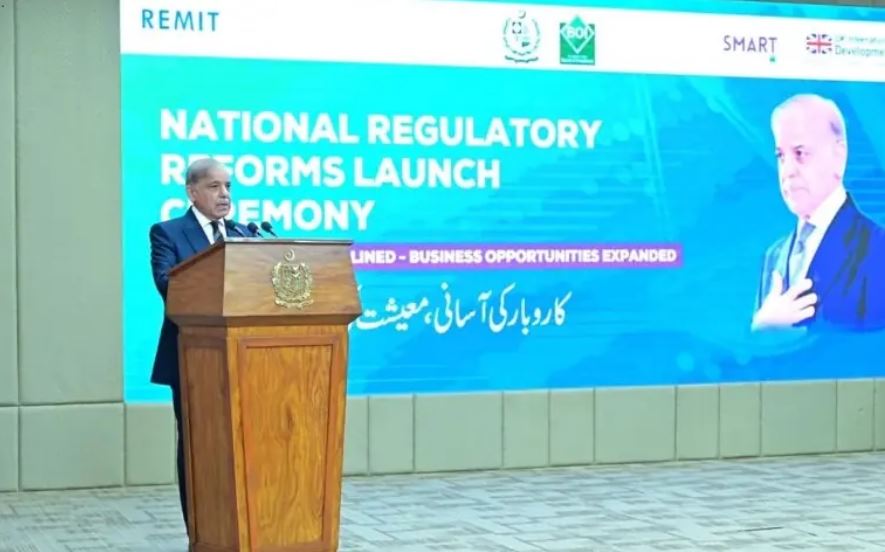
Prime Minister Shehbaz Sharif has confidently declared that Pakistan’s economy is out of the woods, with recent indicators showing a “wonderful” performance. Addressing the launch ceremony of National Regulatory Reforms in Islamabad, the premier emphasized the government’s efforts to stabilize the economy and attract foreign investment, while highlighting support from the IMF, UK, and US.
The announcement reflects the government’s commitment to reviving economic growth, enhancing investor confidence, and providing opportunities for Pakistan’s youth, marking a key turning point in the country’s financial landscape.
IMF Support and Economic Stabilization
The International Monetary Fund (IMF) recently released projections for Pakistan, providing insight into the country’s current economic trajectory:
- Economic Growth: Projected to increase from 2.6% in FY2024 to 3.2% by FY2026.
- IMF Funding: Pakistan received a fresh disbursement of approximately $1.2 billion, reflecting confidence in ongoing reforms.
- Stabilization Path: While immediate risks of economic free fall have eased, challenges such as weak growth, high debt, and limited household relief remain.
PM Shehbaz stressed that through planning, teamwork, and untiring efforts, the government has managed to bring the economy back from turmoil, citing these positive indicators as evidence of progress.
National Regulatory Reforms: A Quantum Leap
The launch of the National Regulatory Reforms represents a major milestone in Pakistan’s economic transformation:
- Objective: Transform Pakistan from a regulatory state into a developmental state, eliminating inefficiencies, corruption, and nepotism.
- Focus Areas:
- Tariff Rationalization: Ensures predictability, competitiveness, and gradual phasing out of arbitrary duties.
- Regulatory Modernization: Streamlines processes for industry, agriculture, and business sectors.
- Export-Led Industrial Revival: Promotes growth in industrial output and trade.
- Impact: Facilitates foreign investment, supports domestic entrepreneurs, and boosts economic productivity.
According to Special Assistant to PM for Industry and Production Haroon Akhtar Khan, the reforms are not standalone efforts but part of a comprehensive strategy for national development.
Focus on Key Economic Sectors
PM Shehbaz highlighted several areas for growth and investment, including:
- Agriculture: Leveraging Pakistan’s fertile land to boost productivity and exports.
- Information Technology: Supporting the IT sector to create high-value jobs for youth and attract foreign companies.
- Mines and Minerals: Unlocking natural resources for industrial development and foreign partnerships.
By focusing on these sectors, the government aims to stimulate economic growth, create employment, and enhance foreign exchange inflows.
Empowering Pakistan’s Youth
A central theme in PM Shehbaz’s remarks was the opportunity for Pakistan’s young population, referred to as the youth bulge:
- Vocational Training: Programs with international certification to equip youth with skills for domestic and global employment.
- Job Creation: Encouraging youth participation in productive employment across key sectors.
- Economic Prosperity: Engaging the younger generation contributes to a stronger economy and social stability.
These initiatives are designed to capitalize on demographic advantages, turning Pakistan’s large youth population into an asset for sustainable growth.
International Cooperation: UK and US Support
PM Shehbaz acknowledged the role of international partners in Pakistan’s economic progress:
- United Kingdom:
- Strong trade links with Pakistan, totaling £5.5 billion annually.
- Collaboration with the Pakistani diaspora in the UK to attract private capital and investment.
- Support for entrepreneurship and business development.
- United States:
- Positive bilateral relations and opportunities for mutual cooperation in trade, investment, and industry.
The premier emphasized that such international partnerships enhance investor confidence and provide a framework for sustainable economic development.
Positive Outcomes of Regulatory Reform
The newly launched regulatory framework aims to deliver tangible benefits:
- Elimination of Bureaucratic Delays: Reducing time wasted on approvals and formalities.
- Minimizing Corruption: Transparent processes to prevent misuse of power.
- Encouraging Investment: Simplified procedures attract foreign direct investment (FDI).
- Boosting Domestic Industry: Streamlined regulations empower local businesses to grow and compete internationally.
Baroness Jenny Chapman of the UK highlighted that these reforms align with Pakistan’s aspirations, opening doors for entrepreneurship and trade.
IMF Projections and Economic Growth
The IMF’s latest projections indicate a gradual economic recovery:
- GDP growth projected to rise to 3.2% by FY2026.
- Fiscal measures and regulatory reforms provide a stabilizing effect on markets.
- Continued IMF support reinforces financial stability and confidence in governance.
PM Shehbaz emphasized that while challenges remain, policy consistency and strategic planning are key to sustaining growth.
Challenges Ahead
Despite positive signs, Pakistan’s economic path faces ongoing challenges:
- High Debt: Managing domestic and external liabilities remains crucial.
- Weak Growth Base: Sustaining growth above IMF projections requires continued reforms.
- Household Relief: Ensuring that economic improvements translate into better living standards for citizens.
- Global Economic Pressures: Navigating trade dynamics, inflation, and energy prices.
Addressing these issues will require continued policy focus, strategic investments, and effective governance.
National Tariff Policy and Trade Facilitation
The national tariff policy aims to create a predictable and competitive environment:
- Predictability: Reducing uncertainty for businesses.
- Competitiveness: Phasing out arbitrary duties to boost exports.
- Trade Facilitation: Enhancing Pakistan’s position in the global supply chain.
By improving trade conditions, Pakistan aims to expand industrial output, create jobs, and increase foreign exchange inflows.
Future Prospects: Developmental State Vision
PM Shehbaz’s vision extends beyond stabilization, aiming to position Pakistan as a developmental state:
- Encouraging foreign investment in sectors of mutual benefit.
- Promoting innovation, entrepreneurship, and industrial growth.
- Leveraging human capital, natural resources, and strategic trade links for national prosperity.
This vision aligns with the government’s commitment to transform the economy, attract investment, and create opportunities for all citizens.
Conclusion: Pakistan on the Path to Economic Revival
Prime Minister Shehbaz Sharif’s announcement reflects optimism and strategic planning in Pakistan’s economic journey:
- Economic Recovery: Out of the woods with positive indicators.
- Regulatory Reforms: Modernizing governance and facilitating trade and investment.
- Youth Empowerment: Vocational training and job creation for a growing population.
- International Cooperation: Leveraging partnerships with the UK, US, and IMF.
While challenges remain, Pakistan is poised to achieve sustainable growth, attract foreign investment, and enhance the welfare of its citizens, marking a critical turning point in the nation’s economic trajectory.