
Meta Description
India’s PSLV rocket lost control shortly after liftoff from Sriharikota, marking the second failure in eight months. Read full details, causes, and impact on ISRO’s space program.
Focus Keyword
Indian rocket launch failure
Related Keywords
ISRO PSLV failure, Indian satellite launch news, PSLV-C62 anomaly, ISRO latest news, Indian space mission setback
Indian Rocket Launch Loses Control After Liftoff, Another Major Setback for ISRO
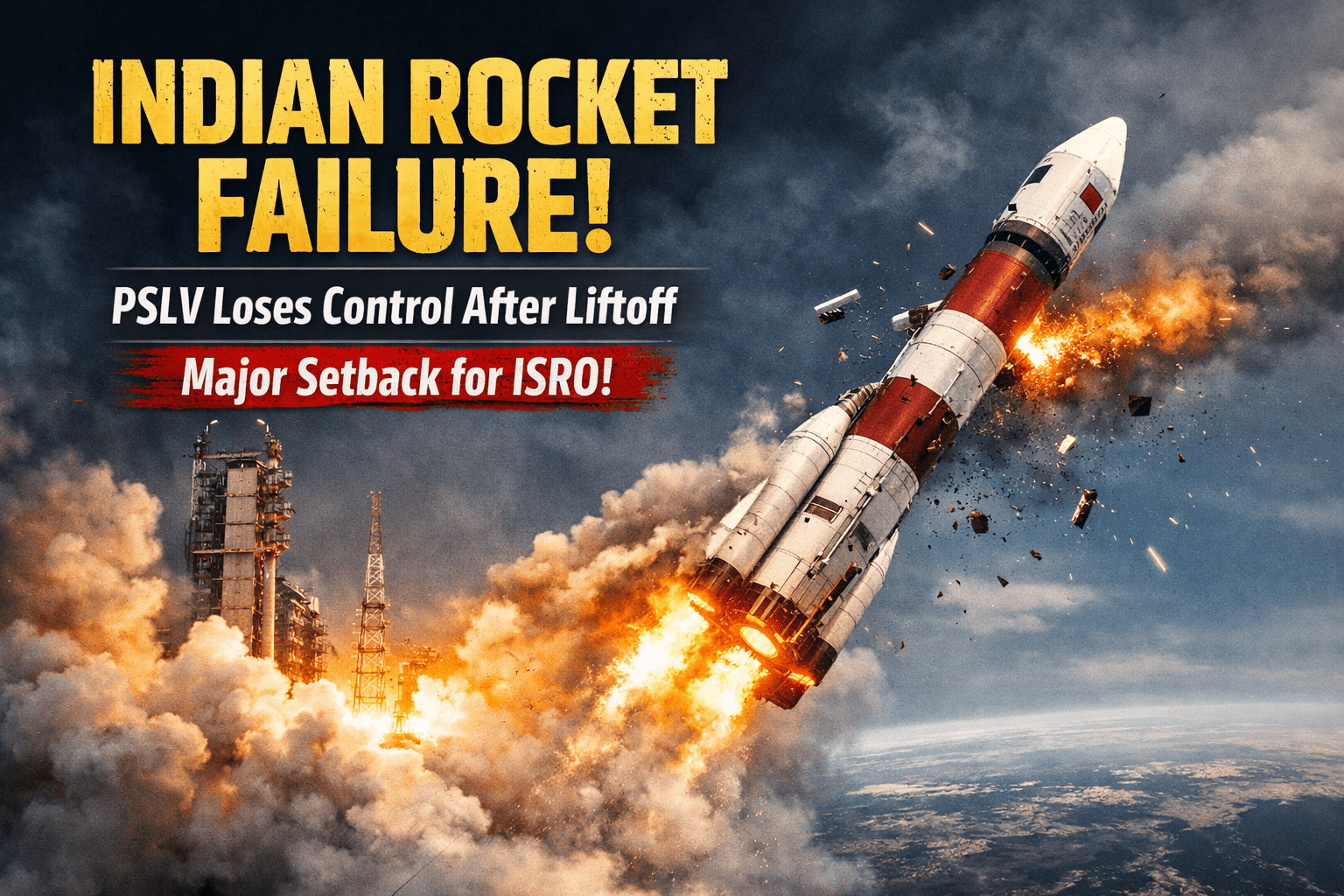
India’s ambitious space programme faced another serious challenge on January 12, 2026, when an Indian rocket launch lost control shortly after liftoff. The incident marks the second failure involving the Polar Satellite Launch Vehicle (PSLV) in less than eight months, raising concerns about reliability and mission readiness at the Indian Space Research Organisation (ISRO).
The failed mission has once again placed ISRO under global scrutiny, especially at a time when India is actively promoting private sector participation in space manufacturing and satellite launches.
What Happened During the PSLV-C62 Launch?
The PSLV-C62 rocket lifted off from the Satish Dhawan Space Centre in Sriharikota at 10:18 a.m. local time. The mission carried the EOS-N1 Earth observation satellite, along with 15 additional payloads developed by startups and academic institutions from India and abroad.
According to ISRO’s mission control, the rocket performed normally during the initial phases of the flight. However, an unexpected disturbance occurred near the end of the PS3 stage, causing the vehicle to deviate from its intended trajectory.
ISRO later confirmed that the mission encountered a technical anomaly, though specific details regarding the cause and final location of the rocket were not disclosed.
ISRO’s Official Statement on the Failure
In a brief statement released shortly after the incident, ISRO said:
“The PSLV-C62 mission encountered an anomaly during the end of the PS3 stage. A detailed analysis has been initiated.”
The space agency did not provide further clarification on whether the satellite payloads were lost or if any recovery efforts were possible.
Second PSLV Failure in Eight Months Raises Concerns
This incident represents the second disappointment for the PSLV in approximately eight months, dealing a significant blow to its long-standing reputation for reliability. Historically, the PSLV has been considered ISRO’s most dependable launch vehicle, often referred to as the “workhorse” of India’s space programme.
Repeated failures within a short timeframe may prompt ISRO to reassess technical processes, quality checks, and mission timelines.
Why the PSLV Is Crucial to India’s Space Program
The PSLV has played a central role in India’s space achievements for decades. Some of its most notable missions include:
- Chandrayaan-1, India’s first lunar mission
- Aditya-L1, India’s solar observatory mission
- Numerous international satellite launches, enhancing India’s commercial launch profile
The rocket has also been a key pillar in India’s strategy to open space launches to private industry, making reliability a critical factor for future partnerships.
Impact on India’s Growing Private Space Sector
One of the most concerning aspects of this failure is its potential impact on India’s emerging private space ecosystem. The PSLV-C62 mission included payloads developed by startups and academic institutions, highlighting ISRO’s role as an enabler for innovation.
Repeated launch failures could:
- Delay startup projects
- Increase insurance and operational costs
- Reduce international confidence in Indian launch services
Possible Technical Causes Behind the Anomaly
Although ISRO has not shared technical details, aerospace experts suggest several possible causes:
1. PS3 Stage Malfunction
The PS3 stage plays a crucial role in stabilizing the rocket before final orbital insertion. Any fault in propulsion, guidance, or control systems could result in trajectory deviation.
2. Sensor or Software Errors
Modern rockets rely heavily on real-time data from sensors. Faulty readings or software glitches can trigger incorrect control responses.
3. Manufacturing or Integration Issues
With increasing payload diversity, integration complexity has grown. Even minor assembly defects can lead to mission-ending failures.
Global Reaction to the Indian Rocket Launch Failure
The incident has drawn attention from international space observers and industry analysts. India has been positioning itself as a cost-effective alternative to Western launch providers, and reliability is a key metric in maintaining global trust.
While one failure may be manageable, repeated issues could influence future commercial contracts.
ISRO’s Track Record: Setback, Not Collapse
Despite recent setbacks, ISRO still maintains a strong overall success rate. Historically, the agency has demonstrated an ability to recover from failures through rigorous investigation and corrective action.
Past examples show that ISRO often returns stronger after setbacks, implementing design improvements and stricter testing protocols.
What Happens Next? ISRO’s Investigation Process
ISRO has already initiated a detailed failure analysis, which typically includes:
- Telemetry data review
- Hardware inspection
- Simulation of failure scenarios
- Independent review committee findings
The results of this investigation will determine whether future PSLV launches face delays or design modifications.
Long-Term Implications for India’s Space Ambitions
India has ambitious goals, including:
- Human spaceflight missions
- Expanded satellite networks
- Increased private-sector launches
- Deep space exploration missions
To achieve these objectives, restoring confidence in launch vehicles like the PSLV is essential.
Conclusion: A Wake-Up Call for ISRO
The Indian rocket launch failure involving PSLV-C62 serves as a reminder that space exploration remains a high-risk endeavor. While the setback is significant, it also presents an opportunity for ISRO to strengthen systems, improve reliability, and reinforce its position in the global space industry.
As investigations continue, the world will be watching closely to see how India’s space agency responds — and whether it can turn this challenge into a stepping stone for future success.