
Blog Draft (2500+ words, natural flow):
In a development that has stunned the world, Venezuelan President Nicolas Maduro was captured in a high-stakes operation conducted by the United States. The dramatic intervention, which saw Maduro whisked away by US forces from Caracas, has sent shockwaves not only through Latin America but also across global political and economic arenas. As the dust settles, questions abound about the legality of the operation, the future of Venezuela, and the broader implications for international relations.
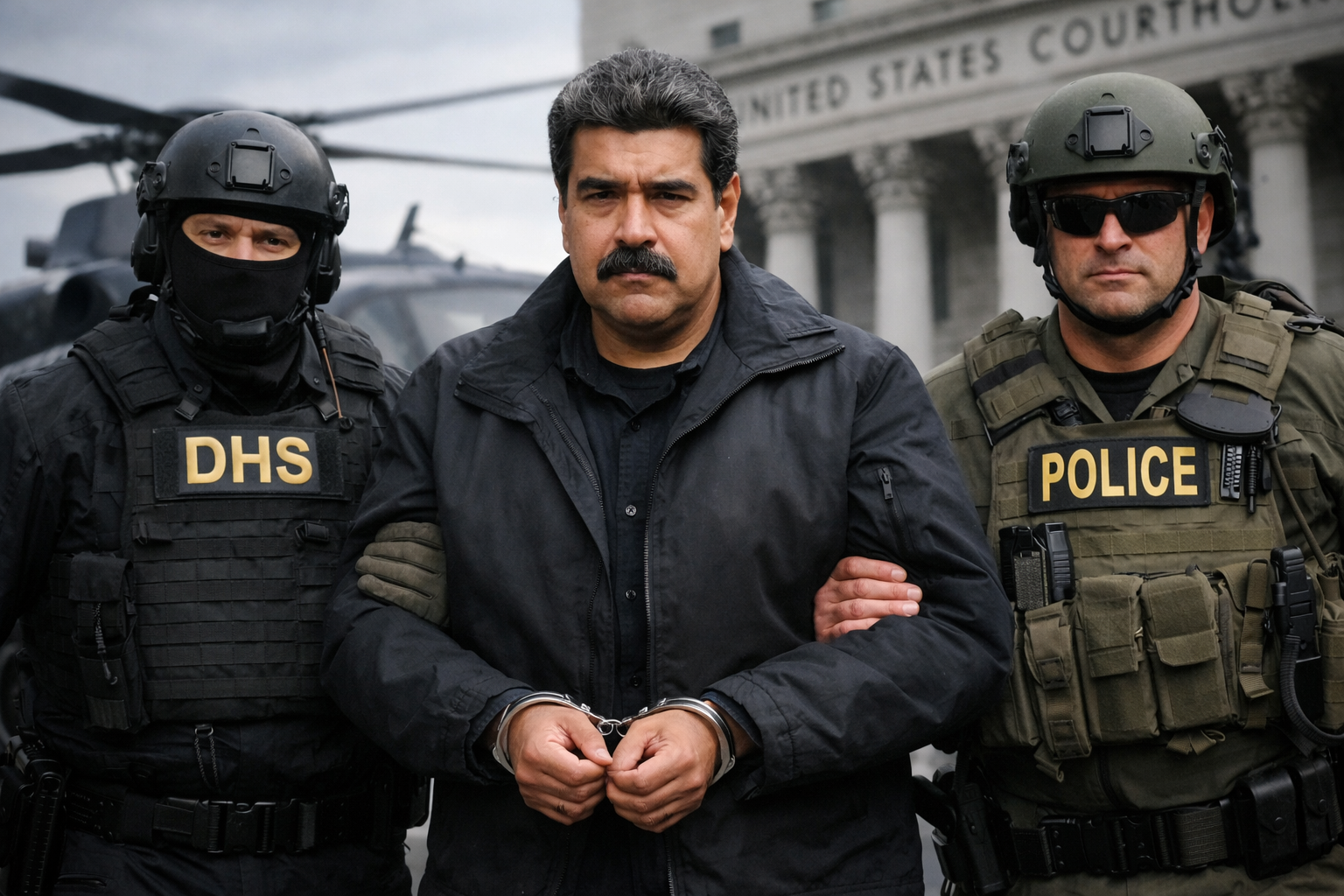
The operation unfolded over the weekend, with US Special Forces reportedly entering Caracas via helicopter. According to reports, Maduro was seized near a secure location, breaking through his protective security detail. Images and videos from the event show Maduro in custody, accompanied by his wife, Cilia Flores, under tight supervision as they were transported to a US-bound helicopter. The audacity of the operation has been compared to some of the most daring interventions in Latin American history, drawing parallels with the 1989 US invasion of Panama.
Once in New York, Maduro faced a federal courtroom for the first time. The charges against him are extensive and severe, including narco-terrorism, conspiracy to import cocaine, and possession of machine guns and destructive devices. Prosecutors have alleged that Maduro oversaw a complex cocaine trafficking network that allegedly collaborated with violent organizations such as Mexico’s Sinaloa and Zetas cartels, Colombian FARC rebels, and Venezuela’s Tren de Aragua gang. These accusations span decades, reportedly beginning from his tenure in Venezuela’s National Assembly and continuing through his service as foreign minister and ultimately as the president succeeding Hugo Chavez in 2013.
Despite the gravity of the charges, Maduro maintains his innocence. Addressing the court, he reportedly stated that he had been “kidnapped” from Venezuela, rejecting all allegations. His defense rests on the argument that the operation was a violation of international law, framing the US intervention as an imperialist intrusion into Venezuelan sovereignty. Maduro’s stance resonates with longstanding criticisms of US policy in Latin America, which many analysts argue has often prioritized strategic and economic interests over diplomatic norms.
The international response to Maduro’s arrest has been immediate and polarized. Within Venezuela, acting President Delcy Rodriguez initially condemned the operation as a “kidnapping” and a colonial-style oil grab, but later adopted a more pragmatic approach, signaling potential willingness to engage with the US on cooperative agendas. This pivot reflects the delicate balance Venezuelan officials must maintain between domestic legitimacy and international pressures.
Globally, reactions have varied widely. The United Nations Security Council convened to discuss the legality and consequences of the operation, with countries such as Russia and China voicing strong condemnation. UN Secretary-General Antonio Guterres raised concerns about regional instability and the potential for the operation to undermine the rules-based international order. Western nations and US allies have generally taken a more measured stance, emphasizing the need for dialogue and adherence to international law, while some political commentators in the United States have praised the operation as a decisive move against a long-standing figure accused of drug trafficking and corruption.
The implications of Maduro’s capture extend beyond politics into the economic realm, particularly the global oil market. Venezuela, home to the world’s largest proven oil reserves at approximately 303 billion barrels, has long struggled with declining production due to mismanagement, underinvestment, and sanctions. The arrest of Maduro has reignited speculation about potential US involvement in Venezuela’s oil sector. President Donald Trump has openly expressed interest in restoring American oil companies’ access to Venezuelan resources, framing the intervention as a reclaiming of what he described as stolen assets.
For the Venezuelan economy, which has been battered by hyperinflation, declining oil output, and social unrest, the US intervention introduces both uncertainty and potential opportunity. While some analysts warn that foreign interference could exacerbate instability, others argue that strategic engagement with international investors could help rebuild infrastructure and revitalize the oil sector, boosting both domestic production and regional economic stability.
Within Venezuela, the political landscape remains complex. Maduro loyalists continue to hold key positions, and the military’s response to the US operation has been closely monitored. Observers note that the success of any transition or cooperation with the United States will hinge on navigating entrenched power structures and maintaining social order in a country of over 30 million people. Meanwhile, opposition figures, who had long hoped for a moment of political breakthrough, find themselves sidelined in the immediate aftermath of the arrest, highlighting the unpredictable nature of Venezuela’s internal politics.
The arrest also raises broader questions about international law and sovereignty. Experts in global legal frameworks have debated whether the operation constitutes an unlawful extrajudicial action or a legitimate response to allegations of criminal activity with transnational implications. The case underscores the tension between national sovereignty and international enforcement when alleged crimes span borders and involve multiple nations.
As the situation develops, attention is turning to the potential scenarios for Venezuela’s future. Will the acting government cooperate with US directives on oil and drug enforcement? Can political stability be maintained without sparking further unrest? How will global powers such as Russia and China respond if US influence grows in a country previously aligned with their strategic interests? Analysts suggest that the coming months will be critical in determining whether Venezuela can navigate this unprecedented crisis without descending into chaos.
Furthermore, the arrest has sparked debates within the United States itself. Supporters of the operation emphasize it as a swift and effective action against an alleged narco-terrorist leader, reinforcing the narrative of prioritizing America’s national security and economic interests. Critics, however, argue that the unilateral action undermines international norms, risks destabilizing the region, and may entangle the US in a prolonged geopolitical conflict. The domestic political implications are also significant, as lawmakers and citizens alike evaluate the ethical and strategic dimensions of the intervention.
The unfolding events in Venezuela exemplify the complex interplay between politics, economics, and international law in a globalized world. From the dramatic capture of a head of state to the strategic maneuvering around oil reserves, every development carries implications far beyond the borders of Venezuela. For Latin America, the operation is a reminder of the enduring influence of external powers and the fragile balance of domestic politics, social order, and economic survival.
As Maduro’s case proceeds through the US judicial system, the global community will be watching closely. Court proceedings, evidence of alleged drug trafficking networks, and the responses of various governments will not only shape the legal outcomes for Maduro but also influence international norms regarding intervention, sovereignty, and transnational criminal accountability. The situation is a test of how the international community balances enforcement of criminal justice against respect for national sovereignty in an increasingly interconnected world.
In conclusion, the arrest of Nicolas Maduro marks one of the most dramatic interventions in recent Latin American history. It intertwines questions of justice, international law, political legitimacy, and economic opportunity. For Venezuela, the stakes are immense, encompassing not just leadership and governance but also the future of the nation’s oil resources and regional stability. For the United States, the operation reflects strategic ambitions that may reshape its role in Latin America for years to come. And for the world, it is a stark reminder of the unpredictable consequences when global politics, criminal accountability, and resource interests collide.
Top 3 Richest Arab Families in 2025: Al Nahyan, Al Saud & Al Thani Wealth Revealed
Most Expensive Overseas Player in IPL History: Cameron Green Sets Record