
Meta Description: North Korea confirms deployment of troops to Russia’s Kursk region to clear mines. Explore the mission, casualties, Kim Jong Un’s speech, and geopolitical implications.
Focus Keywords: North Korea troops Russia, Kim Jong Un news, North Korea mine-clearing mission, Russia Ukraine conflict, DPRK military news, North Korea Russia alliance, North Korea military deployment
North Korea Confirms Troops Deployed to Russia
In a rare and significant acknowledgment, North Korean leader Kim Jong Un confirmed that his troops were sent to Russia’s Kursk region earlier this year to assist in clearing mines amid the ongoing war in Ukraine. The announcement, carried by Korean Central News Agency (KCNA), marks one of the few instances in which Pyongyang openly admits to military involvement abroad.
According to South Korean and Western intelligence agencies, thousands of North Korean soldiers have supported Russia’s nearly four-year-long invasion of Ukraine. This support is believed to be part of a broader arrangement where Russia provides financial aid, military technology, food, and energy supplies to North Korea, helping it circumvent international sanctions.
Details of the Mine-Clearing Mission
Kim Jong Un hailed the return of an engineering regiment that was deployed for 120 days starting in August, praising their courage and dedication. He mentioned that soldiers wrote letters to their hometowns and villages during breaks in their hazardous work.
During the deployment, nine members of the regiment died, and Kim awarded them state honors, highlighting their heroism. According to Kim:
“All of you, both officers and soldiers, displayed mass heroism overcoming unimaginable mental and physical burdens almost every day.”
The troops successfully converted a vast danger zone into a safe and secure area in less than three months, demonstrating remarkable efficiency and resilience.
Images and Ceremonial Recognition
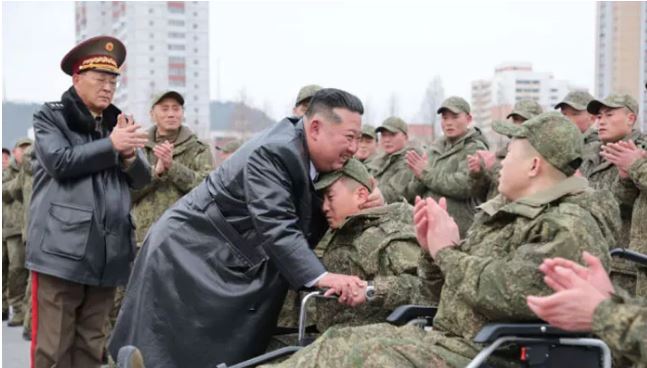
State media released images of Kim Jong Un embracing returned soldiers, some of whom were injured or in wheelchairs. Other images showed Kim consoling families of the deceased, kneeling before a portrait of fallen soldiers, and placing medals and flowers beside their portraits.
Kim highlighted the emotional toll of the mission, emphasizing that he never forgot the soldiers during the 120 days of deployment and praised their unwavering dedication.
Casualties and Honors
The nine deceased soldiers were awarded state honors, described by Kim as a means to “add eternal lustre” to their bravery. The loss of life reflects the deadly nature of mine-clearing operations, which require navigating heavily mined territories left from prior conflicts.
The KCNA coverage focused on the heroism and sacrifice of the regiment, reinforcing North Korea’s narrative of dedication, loyalty, and military prowess under Kim Jong Un’s leadership.
Geopolitical Context: North Korea-Russia Relations
North Korea’s support for Russia is part of a growing military and strategic alliance. Analysts suggest that in return for its support, Pyongyang receives:
- Financial aid and energy supplies to mitigate economic challenges.
- Military technology and weapons systems, supporting the DPRK’s ongoing nuclear and missile programs.
- Food assistance, crucial for a country facing chronic shortages.
This collaboration allows North Korea to sidestep tough international sanctions while reinforcing Russia’s military capabilities amid the Ukraine conflict.
Kim Jong Un’s Public Engagement
Kim’s speeches and public ceremonies honoring the returned soldiers emphasize domestic propaganda and leadership legitimacy. The North Korean leader has consistently highlighted the sacrifice and heroism of soldiers involved in foreign deployments, portraying the regime as protective and responsive to its military personnel.
Recent public appearances include:
- August 2025: Kim embracing returned soldiers, showing emotional support.
- Early July 2025: Honoring flag-draped coffins of deceased soldiers.
- September 2025: Participation alongside Xi Jinping and Vladimir Putin in a Beijing military parade.
These events underline Pyongyang’s efforts to cement alliances with major powers and demonstrate loyalty and bravery among its troops.
North Korea’s Military Deployment in Context
The deployment to Kursk is part of a broader strategy by North Korea to support Russia in the ongoing Ukraine conflict. While Pyongyang confirmed its presence abroad in April 2025, this mine-clearing operation represents one of the most publicly acknowledged deployments.
The DPRK’s involvement demonstrates:
- Willingness to assist Russia militarily in non-combat but high-risk operations.
- Reliance on international alliances to mitigate sanctions and secure resources.
- Ability to mobilize and deploy engineering regiments abroad, showcasing logistical and operational capability.
Human Cost and Sacrifice
Clearing mines is inherently dangerous work, with a high risk of injury or death. The loss of nine soldiers underscores the perils associated with this deployment. Kim’s acknowledgment serves both to honor their memory and reinforce the narrative of heroism and national duty.
The KCNA coverage emphasized that the mission required both mental and physical endurance, reinforcing the idea that North Korean troops are capable of extraordinary feats under extreme conditions.
International Implications
North Korea’s deployment has multiple implications for global security and diplomacy:
- Strengthening Russia’s military capabilities: The mine-clearing mission aids Russian operations in Ukraine, indirectly influencing the conflict’s dynamics.
- Bypassing sanctions: Military and material support from Russia allows North Korea to mitigate the effects of international sanctions.
- Geopolitical signaling: Public acknowledgment sends a message to the international community about North Korea’s capabilities and alliances.
These developments may further complicate diplomatic efforts regarding nuclear non-proliferation and regional security in Northeast Asia.
North Korea’s Strategic Gains
In exchange for its support, North Korea benefits in several ways:
- Financial Assistance: Critical for sustaining the economy and funding military programs.
- Military Technology Transfer: Access to Russian military tech enhances North Korea’s strategic capabilities.
- Energy Supplies: Ensures continuity of operations despite sanctions-related shortages.
This mutual benefit strengthens the Russia-North Korea strategic partnership, making Pyongyang an increasingly important player in Russia’s military and geopolitical strategy.
Kim Jong Un’s Domestic Messaging
The ceremony and public recognition serve multiple domestic purposes:
- Bolstering National Morale: Demonstrating that soldiers’ sacrifices are recognized at the highest level.
- Propaganda Tool: Highlighting North Korea’s international engagements to project strength and capability.
- Legitimizing Leadership: Reinforcing Kim’s image as a caring, decisive, and strategic leader.
These messages are consistent with North Korea’s long-standing practice of using military achievements for domestic legitimacy.
Conclusion: North Korea’s Role in the Russia-Ukraine Conflict
North Korea’s acknowledgment of mine-clearing operations in Russia’s Kursk region underscores its active participation in global military affairs, despite being diplomatically isolated. By supporting Russia, Pyongyang gains strategic advantages, resources, and international leverage while demonstrating its military capabilities.
The mission’s success, alongside the sacrifices made, reinforces North Korea’s narrative of heroism and loyalty under Kim Jong Un, while signaling to the world its continued relevance in major geopolitical conflicts.
As the conflict in Ukraine continues, North Korea’s military cooperation with Russia could have lasting implications for regional security, international sanctions regimes, and global diplomatic relations.