
📝 Meta Description
Norway says its ambassador’s presence at Imaan Mazari’s Supreme Court hearing was lawful and in line with international law, rejecting Pakistan’s objections.
🎯 Focus Keywords
- Norway envoy Pakistan
- Imaan Mazari Supreme Court hearing
- Norway ambassador court hearing
- Pakistan Norway diplomatic issue
- Vienna Convention diplomacy
🔑 LSI / Supporting Keywords
Norwegian foreign ministry, Pakistan Foreign Office, diplomatic protocol, international law, Supreme Court Pakistan, diplomatic norms
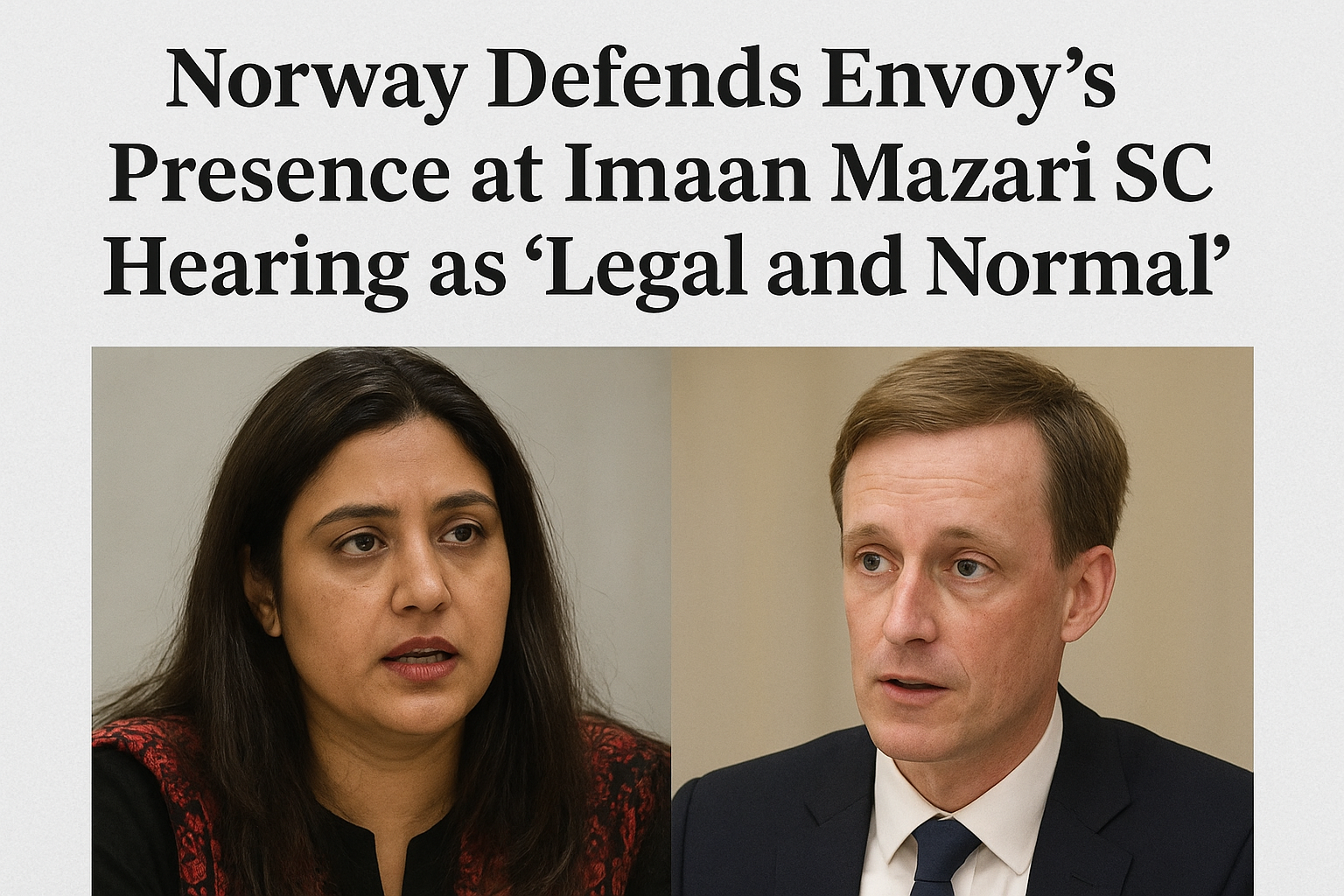
Norway Defends Envoy’s Presence at Imaan Mazari’s Supreme Court Hearing as ‘Legal and Normal’
Norway has strongly defended the presence of its ambassador at a Supreme Court hearing involving Pakistani lawyer and activist Imaan Mazari, calling the move lawful, routine, and fully compliant with international law. The response comes after Pakistan’s Foreign Office (FO) summoned the Norwegian diplomat, alleging interference in internal affairs.
The diplomatic disagreement has sparked debate over diplomatic norms, sovereignty, and the limits of foreign observation in judicial proceedings.
What Happened at the Supreme Court Hearing?
The controversy centers on the attendance of the Norwegian ambassador in Islamabad at a Supreme Court hearing involving Imaan Mazari and her husband, Hadi Ali Chattha.
The hearing related to Mazari’s petition against an Islamabad High Court (IHC) verdict, which had earlier dismissed her plea to halt proceedings in a trial court.
A three-member Supreme Court bench later accepted her plea and ordered that the trial be paused until the IHC issues a final decision.
Norway’s Official Response: “Legal and Completely Normal”
Norway’s Ministry of Foreign Affairs rejected Pakistan’s objections, stating that observing court hearings falls within the routine duties of diplomatic missions.
Statement from Norway
According to Cecilie Roang, senior adviser at Norway’s Foreign Ministry:
“Such lawful presence and observation of a court hearing in the recipient state is within the functions of embassies and is in line with international law.”
She further emphasized that:
- Diplomatic missions regularly observe court cases worldwide
- Especially cases involving public interest or legal significance
- Reporting developments back to their home country is a core diplomatic responsibility
Pakistan’s Foreign Office Objects
Despite Norway’s clarification, Pakistan’s Foreign Office took a firm stance against the ambassador’s presence.
FO Statement Highlights
FO spokesperson Tahir Andrabi said:
- The Norwegian ambassador was summoned by the Additional Foreign Secretary (Europe)
- His presence was termed a breach of diplomatic protocol
- Pakistan argued the act violated norms under the Vienna Convention
“The ambassador was urged to adhere to established norms of diplomatic engagement,” Andrabi said.
Pakistan maintains that such actions amount to interference in internal affairs.
Imaan Mazari Defends Diplomatic Observation
Imaan Mazari herself defended the Norwegian envoy’s presence, dismissing criticism on social media.
Responding to a post on X (formerly Twitter), Mazari stated:
“Diplomats routinely observe court proceedings — that is not equivalent to them taking a position on any case. This is a standard practice.”
Her remarks align with Norway’s position that observation does not equal interference.
Legal Case Background: Why Were Mazari and Chattha Charged?
Mazari and her husband were booked by the National Cyber Crime Investigation Agency (NCCIA) under Pakistan’s Prevention of Electronic Crimes Act (PECA), 2016.
Charges Include:
- Sections 9, 10, 11, and 26 of PECA
- Allegations of inciting divisions on linguistic grounds
- Social media posts cited as evidence
The couple was indicted on October 30, sparking criticism from human rights activists and legal observers.
Diplomatic Norms & Vienna Convention Explained
Under the Vienna Convention on Diplomatic Relations, diplomats are allowed to:
- Gather information by lawful means
- Attend public court hearings
- Report political and legal developments
Norway argues that its envoy’s actions fall squarely within these provisions, while Pakistan interprets them as overstepping boundaries.
Growing Diplomatic Sensitivity
The incident reflects broader sensitivities around:
- Foreign diplomatic involvement
- Judicial independence
- Sovereignty concerns
While Western nations often view court observation as transparency-driven, host countries may see it as political signaling.
Conclusion: Diplomatic Dispute or Routine Practice?
The disagreement between Pakistan and Norway highlights contrasting interpretations of diplomatic conduct. While Norway insists the ambassador’s presence was “legal and normal,” Pakistan views it as a violation of protocol.
As the legal proceedings involving Imaan Mazari continue, the episode underscores the delicate balance between diplomacy, sovereignty, and international norms.