
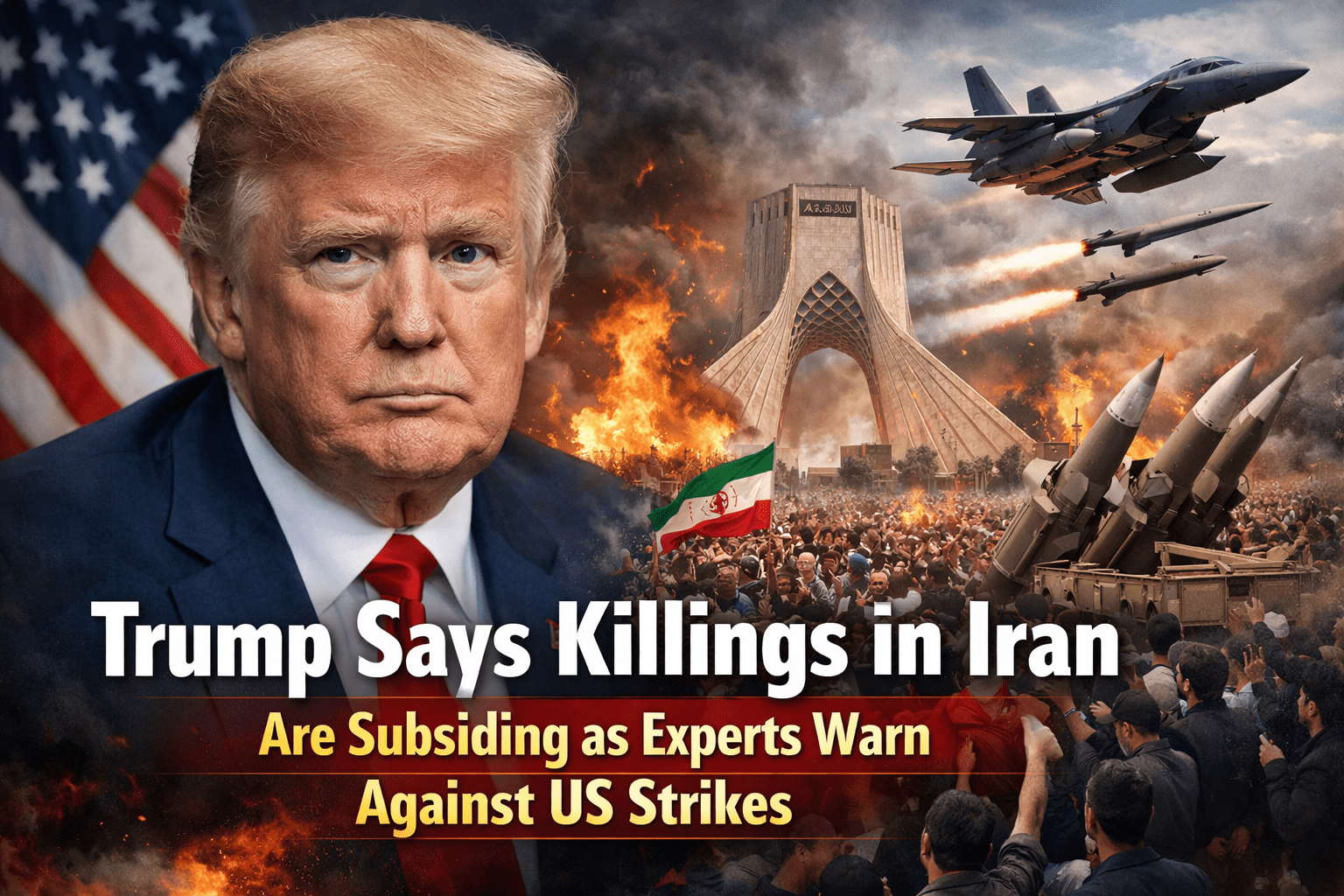
Introduction: Iran Crisis Enters a Dangerous New Phase
The political crisis in Iran has entered one of its most volatile phases in decades. As nationwide anti-government protests continue to shake the country, US President Donald Trump has claimed that killings during Iran’s security crackdown are “subsiding.” However, international experts, intelligence analysts, and regional diplomats warn that any US military intervention could backfire badly—either intensifying repression or triggering widespread chaos across the Middle East.
This unfolding situation has become a high-stakes geopolitical puzzle involving human rights concerns, nuclear risks, regional security, and global diplomacy.
Trump’s Statement on Iran Protests: ‘We Are Going to Watch’
During an Oval Office appearance on Wednesday, President Donald Trump told reporters that credible sources inside Iran had indicated a decline in killings linked to the government’s crackdown on protesters.
Trump said:
“Very important sources on the other side have told us that the killings are subsiding.”
He also added that he currently believes there is no plan for large-scale executions, though he emphasized that the United States is closely monitoring developments.
Despite the cautiously optimistic tone, Trump did not rule out military action. Instead, he stated that the US administration would “watch what the process is”, leaving the door open for intervention if Iran’s actions escalate.
Rising Fears of US Military Action in the Middle East
While Trump’s comments offered some reassurance, they also reignited fears across the Middle East. Gulf Arab governments, according to regional diplomats, are increasingly alarmed about the possibility of US airstrikes on Iranian targets.
One diplomat, speaking anonymously, said:
“Gulf governments are freaking out. In every conversation with Americans and Iranians, they’re asking everyone to calm down.”
These concerns intensified after reports emerged that the US had begun withdrawing some personnel from the region, a move often seen as a precautionary step before military escalation.
Iran Warns of Retaliation Against US Bases
Tensions escalated further when a senior Iranian official reportedly told neighboring countries that US military bases in the region would be targeted if America launched strikes against Iran.
This warning has heightened anxiety among US allies hosting American troops, particularly in Iraq, Kuwait, Qatar, Bahrain, and the United Arab Emirates.
Such retaliation could potentially lead to a regional conflict, drawing multiple countries into direct confrontation.
Experts Warn: Military Intervention Could Backfire
Security analysts and diplomats caution that US military intervention in Iran could produce unintended and dangerous consequences.
According to multiple experts:
- Airstrikes could smother ongoing protests by allowing Iranian authorities to label dissenters as foreign-backed enemies.
- Military action might trigger an even harsher crackdown on demonstrators.
- Retaliatory missile attacks could target US bases and allied infrastructure across the Middle East.
Several intelligence assessments reviewed earlier this week reportedly concluded that while the protests pose a serious challenge to Iran’s leadership, the government does not appear close to collapsing.
Worst-Case Scenario: Chaos in a Nation of 90 Million
In more extreme scenarios, analysts warn that US strikes could accelerate the collapse of Iran’s central government—potentially unleashing chaos across a country of over 90 million people.
Such a collapse could lead to:
- Insurgencies by Kurdish and Baluch separatist groups
- Loss of control over nuclear materials
- Disruption of missile command and control systems
- Massive refugee flows across the region
Behnam Ben Taleblu of the Foundation for the Defense of Democracies summed up the risks bluntly:
“We have restive ethnic minorities, loose undeclared fissile materials, and dispersed missile stocks. All the fears that come with regime change would be expedited.”
Iranian Foreign Minister Denies Execution Plans
Amid mounting international scrutiny, Iranian Foreign Minister Abbas Araqchi attempted to ease fears during an interview with Fox News.
He stated unequivocally:
“There is no plan for hanging at all. Hanging is out of the question.”
His comments directly addressed reports suggesting that Iran planned to execute arrested protesters—a claim that had drawn strong condemnation from Western governments and human rights organizations.
Scale of the Protests: A Historic Challenge to Iran’s Leadership
The protests are widely regarded as the largest domestic challenge to Iran’s clerical establishment since the 1979 Islamic Revolution.
What began as localized demonstrations has evolved into nationwide unrest, with massive crowds demanding the ouster of the government and clashing with security forces.
According to official Iranian figures, more than 2,000 people have died since protests erupted on December 28. Independent rights groups estimate the death toll exceeds 2,600, while many experts believe the true number may be significantly higher.
Silence from Washington and Tehran
Despite the gravity of the situation, both the White House and Iran’s delegation to the United Nations declined to respond immediately to requests for comment.
This silence has fueled speculation about behind-the-scenes diplomatic efforts—or preparations for more forceful action.
Diverging Views Among Opposition Figures
Not all opposition voices oppose US intervention.
Abdullah Mohtadi, leader of the Komala Party of Iranian Kurdistan, dismissed concerns about separatism and argued that only decisive US military action could halt the killing of protesters.
He said:
“The chaos is already there. The most important thing is to stop the massacre of people.”
Mohtadi believes opposition groups could unite to replace Iran’s theocratic system with a democratic government, should external pressure weaken the regime.
Trump’s Track Record: Iran and Beyond
Trump’s stance on Iran cannot be viewed in isolation. In June, he ordered strikes on three Iranian nuclear sites during a brief but intense conflict between Israel and Iran.
More recently, his administration cited the US-led intervention in Venezuela, which contributed to the downfall of President Nicolas Maduro, as evidence that decisive action works.
According to a White House official, Trump’s continued pressure on Tehran is also intended to signal to US adversaries that Washington remains willing to use military power.
US Officials Reviewing Military Options
Sources familiar with internal discussions say Trump’s aides are reviewing a range of military options, including:
- Limited strikes on symbolic military targets
- Precision attacks designed to avoid civilian casualties
- Cyber operations targeting Iran’s security apparatus
However, experts warn that symbolic strikes could be counterproductive if they fail to meaningfully weaken security forces.
Cyber Warfare and Economic Pressure as Alternatives
Some analysts argue that non-military tools could prove more effective.
Jon Alterman of the Center for Strategic and International Studies suggests that cyber-attacks and financial measures could disrupt Iran’s ability to suppress protests without triggering immediate retaliation.
He explained:
“A military action would make everyone expect instant results—or complain that it wasn’t working.”
Interrupting Iran’s cash flows and undermining internal coordination might give protesters more time and space to organize.
The Credibility Question for Trump
Analysts say Trump now faces a credibility dilemma.
Having repeatedly warned of intervention, failing to act if Iran escalates its crackdown could weaken his position on the global stage. On the other hand, military action carries enormous risks.
As Taleblu noted, the choice of targets will determine whether intervention fuels or dampens protests.
Middle East on Edge as Crisis Continues
Across the region, governments are urging restraint. Diplomatic channels are buzzing with urgent calls for de-escalation, as the Middle East braces for what could be a defining moment in regional politics.
Whether the crisis leads to reform, repression, or war may depend on decisions made in the coming days—both in Tehran and Washington.
Conclusion: A Delicate Balance Between Pressure and Restraint
Trump’s assertion that killings in Iran are subsiding has offered a glimmer of hope amid an otherwise grim situation. Yet, the broader picture remains deeply uncertain.
With protests ongoing, death tolls disputed, and military options under review, the risk of miscalculation is high. Experts agree on one point: any US intervention must be carefully calibrated—or it could unleash consequences far beyond Iran’s borders.
For now, the world watches closely as Iran’s crisis unfolds—one decision away from reshaping the Middle East.
SEO Section (WordPress Ready)
🔑 Focus Keyword
Trump Iran protests
🔑 Secondary / LSI Keywords
- US military intervention Iran
- Iran protests crackdown
- Trump Iran strikes
- Iran executions denial
- Middle East tensions US Iran
- Iranian protests 2026
🧲 Meta Title
Trump Says Killings in Iran Are Subsiding as Experts Warn Against US Strikes
📝 Meta Description
Trump claims killings in Iran’s protest crackdown are easing, but experts warn US military intervention could backfire, triggering chaos and regional conflict.