
Meta Title (SEO)
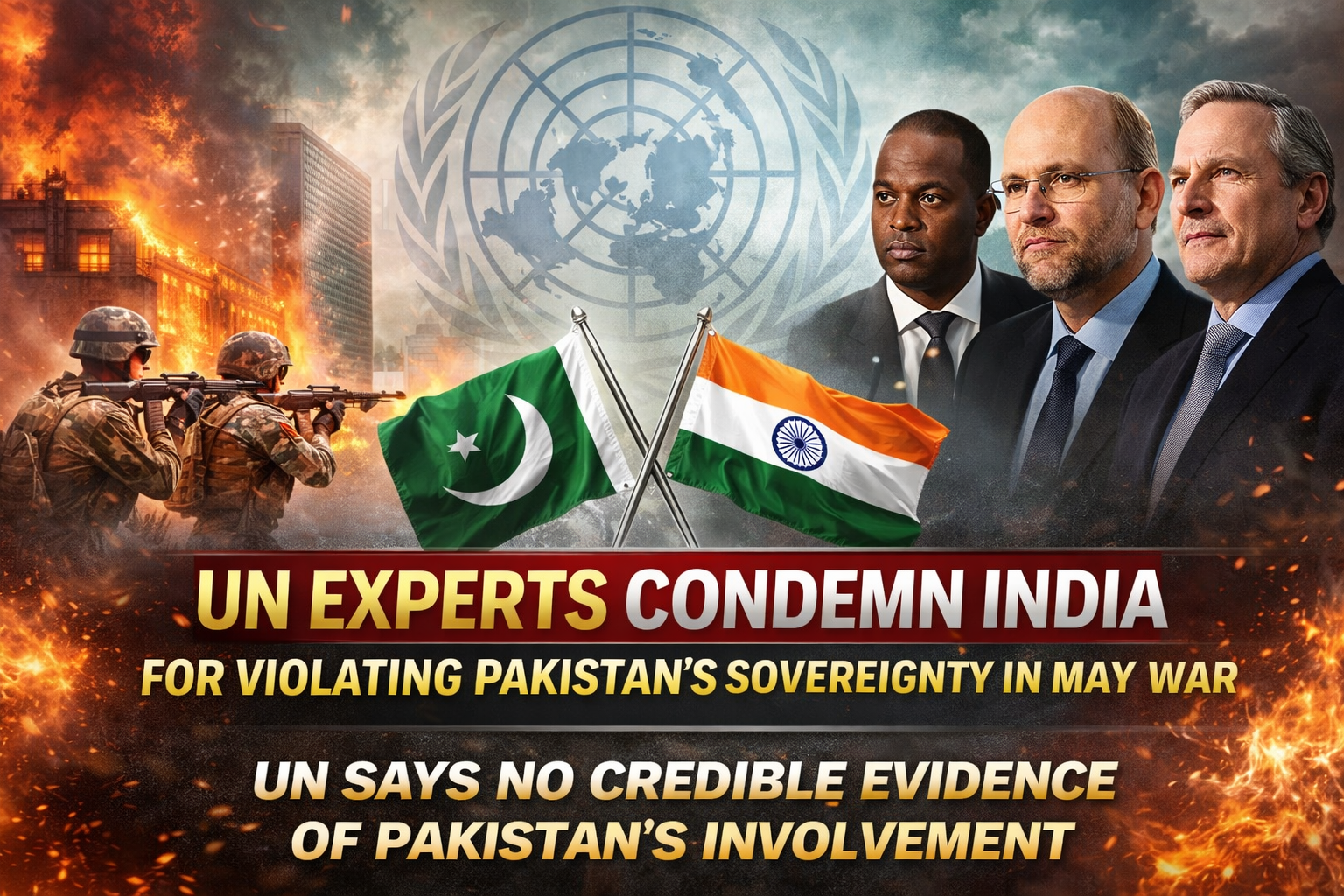
UN Experts Slam India for Violating Pakistan’s Sovereignty in May War
Meta Description (SEO)
UN experts criticise India for unlawful use of force against Pakistan in May, citing civilian casualties, lack of evidence, and violations of UN Charter.
Focus Keyword
UN experts on India Pakistan conflict
Secondary Keywords
India violation of Pakistan sovereignty, May conflict Pakistan India, UN Charter violation India, Pahalgam attack evidence, Indus Waters Treaty UN concern
Introduction
United Nations human rights experts have strongly criticised India’s unilateral military actions inside Pakistan during the May conflict, reaffirming Islamabad’s long-standing stance that New Delhi violated Pakistan’s sovereignty and the principles of the United Nations Charter.
According to a report cited by Radio Pakistan, UN experts questioned the legality of India’s use of force, highlighted civilian casualties, and stressed that no credible evidence was presented linking Pakistan to the Pahalgam attack, which India had cited as justification for its actions.
UN Experts Question India’s Use of Force
The UN human rights experts noted that India’s actions on May 7 constituted a breach of international law.
Key Observations by UN Experts
- India carried out unilateral military strikes inside Pakistan
- The use of force violated UN Charter principles
- Civilian areas were reportedly targeted
The experts emphasised that international law does not recognise any right to unilateral military action under the guise of counterterrorism.
Civilian Areas and Mosques Targeted
According to the UN report, Indian attacks during the conflict:
- Hit civilian neighbourhoods
- Targeted mosques
- Resulted in the killing and injury of multiple civilians
The experts raised serious concerns over the human cost of the attacks, stressing that civilians and protected sites must not be targeted under international humanitarian law.
No Credible Evidence on Pahalgam Attack
One of the most critical points raised in the report was India’s failure to provide credible evidence linking Pakistan to the Pahalgam attack.
The UN experts stated that:
- Allegations alone cannot justify military aggression
- Evidence must meet international legal standards
- Force cannot be used without independent verification
This assessment directly supports Pakistan’s claim that India acted without lawful justification.
Four-Day Armed Conflict Between Nuclear Neighbours
The report referred to the four-day armed conflict between the two nuclear-armed countries following India’s strikes inside Pakistan.
Impact of the Conflict
- Several Pakistani civilians and security personnel were martyred
- Regional tensions escalated dangerously
- International concern grew over possible wider escalation
The experts warned that such conflicts pose a grave threat to regional and global peace.
Pakistan’s Response: Operation Bunyan-um-Marsoos
In response to the Indian strikes, Pakistan:
- Downed multiple Indian fighter jets
- Launched retaliatory strikes under “Operation Bunyan-um-Marsoos”
- Targeted over 20 Indian military sites across different regions
Pakistan maintained that its response was defensive and proportionate, aimed at deterring further aggression.
US-Brokered Ceasefire Ends Hostilities
The hostilities eventually came to an end on May 10, after both countries agreed to a US-brokered ceasefire.
The ceasefire was widely welcomed by the international community, which had urged restraint amid fears of a broader military confrontation.
UN Experts Raise Alarm Over Indus Waters Treaty
Beyond military concerns, UN Special Rapporteurs also expressed deep concern over India’s decision to put the Indus Waters Treaty in abeyance.
Why the Treaty Matters
- It governs water sharing between Pakistan and India
- Millions in Pakistan depend on Indus Basin waters
- Any disruption threatens livelihoods and food security
The experts warned that water must never be used as a political or economic weapon.
Threat to Fundamental Human Rights
The UN experts highlighted that interference with transboundary water flows directly affects fundamental rights, including:
- 🚰 Right to water
- 🌾 Right to food
- 💼 Right to employment
- 🏥 Right to health
- 🌍 Right to a clean environment
- 📈 Right to development
They stressed that millions of Pakistanis could suffer if water flows are obstructed.
Water Cannot Be Used as Political Pressure
Emphasising international legal norms, the report stated that:
- Interference with transboundary water rights must be avoided
- Water should not be weaponised for political leverage
- Such actions risk humanitarian crises
This stance further strengthens Pakistan’s position on the Indus Waters Treaty dispute.
International Law and Regional Stability
UN experts warned that unilateral actions and disregard for international agreements undermine:
- Global rule-based order
- Regional stability in South Asia
- Peace between nuclear-armed neighbours
They called for dialogue, evidence-based accountability, and respect for international law.
Pakistan’s Stance Vindicated
The findings of the UN experts align closely with Pakistan’s narrative that:
- India violated its sovereignty
- Civilian lives were endangered
- International law was ignored
Officials in Islamabad have repeatedly demanded independent investigations and adherence to UN principles.
Conclusion
The UN experts’ report delivers a strong rebuke to India’s actions during the May conflict, reinforcing concerns over sovereignty violations, civilian casualties, lack of evidence, and the misuse of force.
By also raising alarm over the Indus Waters Treaty, the experts highlighted how military and economic pressure tactics can severely impact human rights. The report underscores the urgent need for restraint, accountability, and diplomacy to ensure lasting peace in South Asia.
Top 3 Richest Arab Families in 2025: Al Nahyan, Al Saud & Al Thani Wealth Revealed
Most Expensive Overseas Player in IPL History: Cameron Green Sets Record